Tuesday, March 26, 2013

Swing Street

...the bebop era really only lasted from about, maybe, 1943 when Billy Eckstine's band was one of the first bebop bands, to about 1955. And it went up until 1965... Birdland, I think, opened up in 1949 and stayed open... uh... it stayed open until 1965.

'Cause I played at the original Birdland. And they had other places - 'cause all these guys like Symphony Sid, they had these radio broadcasts that were on major radio stations... like on A.M., 'cause after midnight that.. those stations would carry damn near 'cross the country.

So, you know, you had Sid McCoy out of Chicago -- like that was in the late '50s/early '60s... Y'had Al "Jazzbo" Collins - he was in New York - and y'know, Symphony Sid used to do stuff at a place called the Royal Roost, on 48th Street and Broadway, that was upstairs; that's why they called it the Royal Roost.

And then you had 52nd Street itself, between... uh, Sixth and Fifth Avenue - that block was what they called "Swing Street": that's where bebop was founded.

The only place that's still down there, in its natural... in its pristine state, is 21... which is the jockey club. On that same block... they used to all be brownstones, just like that... and the Onyx Club, 3 Deuces... [there] were all these famous... jazz joints, where Charlie Parker and Dizzy Gillespie and all them cats played. Y'know.. it was just one block long, and they used to go from club to club, right in that block. Jimmy Ryan's and all them... and all that kinda stuff...

Enhanced by Zemanta

Thursday, December 6, 2012

Soul eyed Blues

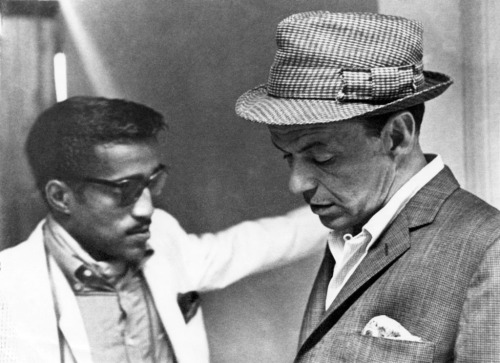
You know, Frank Sinatra was Vito Genovese's godson... or some stuff
-- related to him, 'cause, you know, blue-eyed skinny kid from Hoboken, New Jersey. But y'know, see Frank, man... Frank helped a *lot* of guys, y'know... he's the one that really catapulted Sammy Davis, Jr's career... he helped out Sammy a lot. And they used to work at the Paramount you know like, in the '40s -- bobby soxers days... but all that stuff was real segregated then. That's why everybody went uptown.. after the places closed downtown, everybody went uptown and hung out -- that's why Minton's Playhouse had it's famous after hours joint.

And the famous jam sessions that happened after hours... now, that was on 118th Street, between, uh... 7th Avenue and St. Nick. The after hours joint... the entrance was on the Saint Nicholas Avenue side, between 117th and 118th, down in the basement. To this day, the original piano is still down there, from the jam session. You see, 'cause, that was where George Gershwin and them went and hung out... and that's where they got a lot of the stuff.. y'know, that they got...


Sunday, November 25, 2012

Each One, Teach One

[What] existed in the past that you're not having happen any more - it's called the apprenticeship program. The apprenticeship program... that's how everybody comin' up played in somebody's band at some point or another... it helped them to develop what and who they are today.

You know but... the unfortunate thing - a lot of those masters, [those] who became masters doing due diligence in the field, when they died off that was the end of a whole generation. That's why the apprenticeship program brought people into the fold, [such] that if you sat in a band, you sat next to a master and you learned how to blend and read the word, here, 'cause... they used to tell me "if you can't hear everyone in the band playing, you're playing too loud".

So you gotta have to learn how to listen to people, learn how to phrase, learn how to breathe. And see, that was an integral part of the... y'know, like when, y'know, most guys like Donald Byrd and them went to college and , y'know - but when they worked with Art Blakey, that was their on the job training, that got them to their next degree...